The CISO Said No to Every AI Tool. Here's Why That's a Reasonable Position.
The approval problem nobody talks about openly
Teams evaluating AI operations tooling for their physical infrastructure estate run into the same wall. The tool looks good. The demos are convincing. The vendor's customer list is credible. And then InfoSec or the CISO reviews the data flow diagram and the conversation stops.
Asset inventory, power telemetry, rack configurations, physical network maps. This is detailed operational intelligence about your most critical infrastructure. Sending it to a cloud model, often hosted by a hyperscaler in a foreign jurisdiction, isn't just a data classification concern. For banks and government agencies operating under RBNZ or APRA obligations, it can be a direct compliance problem.
So the CISO says no. And the team goes back to managing a complex estate with spreadsheets and instinct.
Why most AI-ops tools can't solve this
The SaaS-first AI operations vendors aren't being careless. Their architecture makes sense for the majority of their market, organizations without a hard sovereignty constraint, where cloud-hosted inference is fine.
But the regulated buyer is a different situation. The binding constraint isn't preference. It's regulatory obligation. RBNZ outsourcing rules for NZ systemic banks create specific requirements around where critical processing happens and who controls the operational environment. APRA CPS 234 has direct implications for where you send data about your information assets.
A tool that can't operate inside your control perimeter isn't just inconvenient for this buyer. It's genuinely not an option.
The DCIM incumbents have the same problem in a different packaging
The established DCIM vendors have been adding AI features. But those features typically run through the vendor's own cloud infrastructure. So you get the intelligence layer, but only if you're willing to push your data outside your boundary to get it.
For an organization that has specifically retained workloads on premises because of sovereignty and regulatory obligations, that trade-off doesn't work. You're not going to satisfy a CISO's data residency requirements by pointing to the vendor's SOC 2 report.
What 'AI inside your boundary' actually means
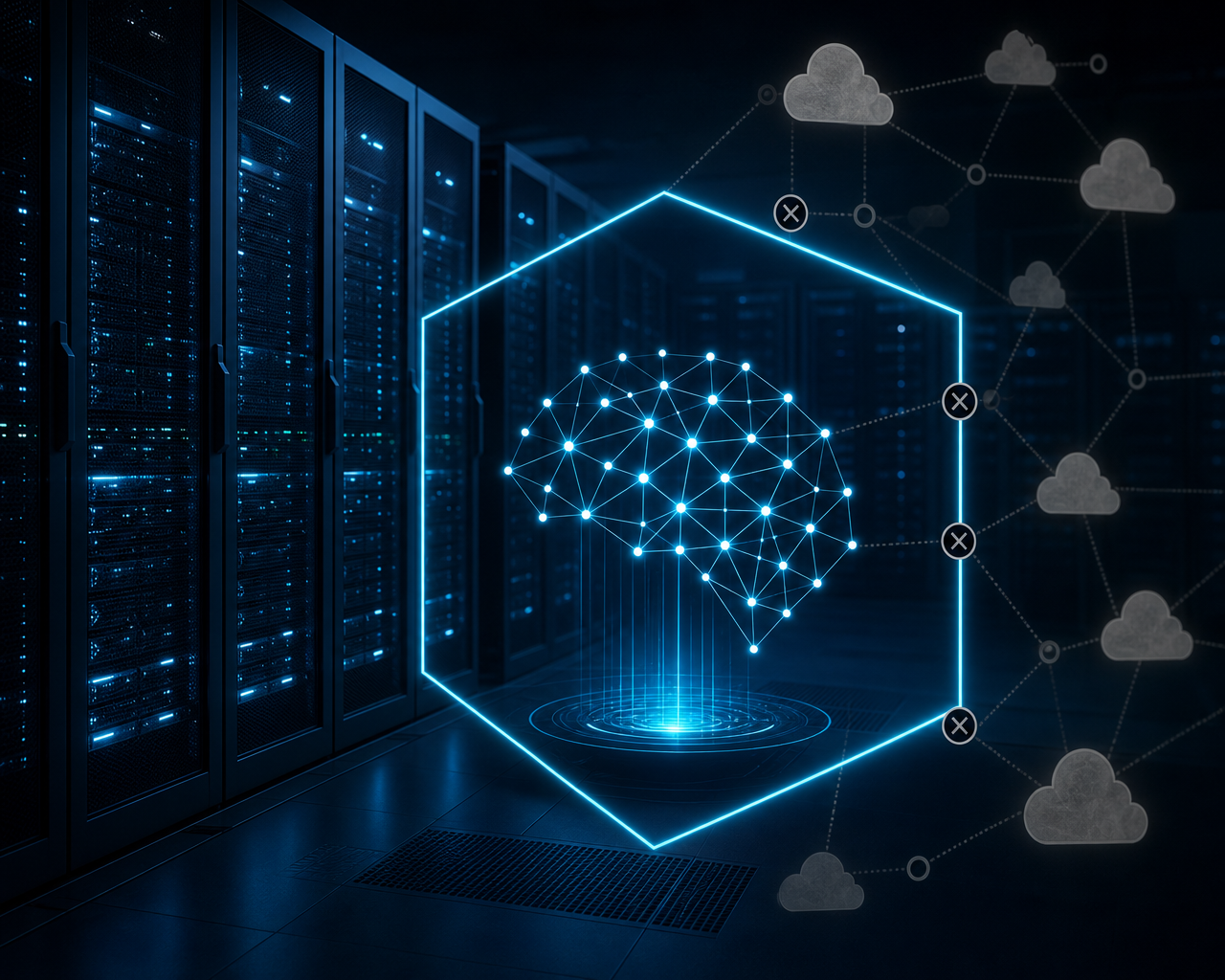
CenterOS runs AI inference, the models themselves, and the data those models learn from entirely inside the customer's own control perimeter. Nothing is sent to an external service. Nothing touches a cloud endpoint. The processing happens on infrastructure the customer controls, under governance the customer owns.
This matters practically for a few reasons:
- Your CISO can review the architecture and approve it without compromise
- Your InfoSec function can audit the AI's behavior and outputs
- Your regulator can be shown exactly how the AI works and where the data lives
- The recommendation the AI made about your power capacity last Tuesday is documented, explainable, and traceable inside your own systems
That last point is underrated. Explainability under regulatory scrutiny isn't just a nice property for AI to have. For a bank or government agency, it's a requirement. If your infrastructure team is acting on AI recommendations and your risk function can't explain what those recommendations were based on, that's a control gap.
This isn't a niche constraint
Every NZ systemic bank, every APRA-regulated entity managing a retained estate, every government agency with data-sovereignty hosting requirements, faces exactly this constraint. It's not a small population. It's just a population that's been treated as a rounding error by vendors focused on cloud and hyperscale growth.
CenterOS was built specifically for this buyer. Sovereign AI isn't a feature added to satisfy an edge case. It's the foundation the platform was designed around from the start.
Your AI. Your boundary. Your infrastructure, under control.
CenterOS
The AI-native DCIM that runs anywhere — including inside your perimeter
The AI-native DCIM that runs anywhere — including inside your perimeter
Learn more about CenterOS and get started today.
Visit CenterOS